

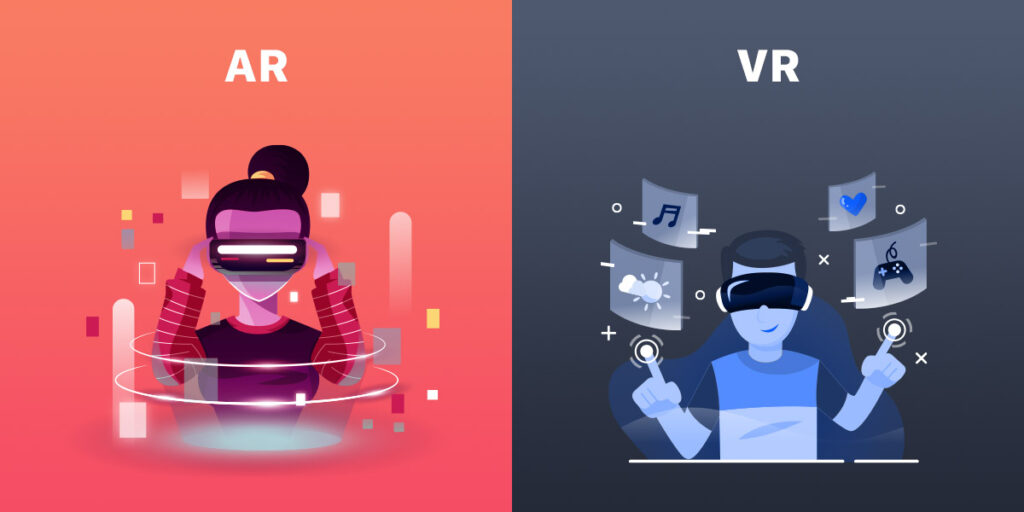
The ongoing evolution of digital technologies has brought us to the brink of a new era defined by Augmented Reality (AR) and Virtual Reality (VR). These immersive technologies promise to transform the way we interact with the digital world, offering experiences that blend or completely replace our perception of reality. As we look towards the next decade, a key question emerges: Which technology will dominate? This article delves into the intricacies of AR and VR, comparing their capabilities, applications, and potential to reshape various industries.
Understanding Augmented Reality (AR)
Augmented Reality enhances our real-world environment by overlaying digital information, such as images, videos, and sounds, onto it. This blending of digital and physical worlds is achieved through devices like smartphones, tablets, and AR glasses. The goal of AR is not to create a completely new environment, but to enrich the existing one with additional layers of information.
Key Features of AR
- Real-World Integration: AR seamlessly integrates digital elements into the user’s real-world environment.
- Interactive Experience: Users can interact with digital objects as if they were part of the real world.
- Accessibility: AR can be accessed through common devices such as smartphones and tablets, making it more widely available.
Applications of Augmented Reality
AR has already found its way into various sectors, demonstrating its versatility and potential for widespread adoption.
Healthcare
In healthcare, AR can assist surgeons by providing real-time data during procedures, improving accuracy and outcomes. Medical students can also benefit from AR-based simulations for enhanced learning experiences.
Retail
Retailers use AR to create interactive shopping experiences. Customers can visualize products in their homes before making a purchase, reducing the uncertainty associated with online shopping.
Education
AR offers immersive learning experiences by bringing textbooks to life. Students can explore 3D models of complex concepts, making education more engaging and effective.
Understanding Virtual Reality (VR)
Virtual Reality creates a completely immersive digital environment, shutting out the physical world and transporting users to a fully interactive virtual space. This is achieved using VR headsets that cover the user’s field of vision, along with motion controllers and sensors to track movements.
Key Features of VR
- Full Immersion: VR provides a fully immersive experience, isolating users from the real world.
- Interactive Environments: Users can interact with and manipulate the virtual world, enhancing the sense of presence.
- High Fidelity: VR environments can be highly detailed and realistic, offering a sensory-rich experience.
Applications of Virtual Reality
VR’s ability to create entirely new worlds makes it ideal for applications where immersion is key.
Gaming and Entertainment
The gaming industry has been a major driver of VR adoption, offering players fully immersive experiences that traditional gaming cannot match. Beyond gaming, VR is being used for virtual concerts, film experiences, and social interactions.
Training and Simulation
VR is widely used for training in high-risk fields such as aviation, military, and emergency response. Simulations in VR can replicate dangerous scenarios safely, providing invaluable hands-on experience.
Therapy and Rehabilitation
In the medical field, VR is used for therapy and rehabilitation, helping patients recover from injuries or manage chronic pain through immersive, controlled environments.
Comparative Analysis: AR vs. VR
While both AR and VR offer unique benefits, their differing approaches to digital interaction mean they are suited to different applications.
Accessibility and Adoption
- AR: More accessible due to the widespread availability of smartphones and tablets. Easier for users to adopt as it does not require specialized equipment.
- VR: Requires specific hardware, such as VR headsets and controllers, which can be a barrier to widespread adoption.
User Experience
- AR: Enhances the real world, making it ideal for applications that require interaction with the physical environment.
- VR: Provides a completely immersive experience, perfect for scenarios where total engagement is desired.
Market Potential
- AR: Expected to see rapid growth in sectors like retail, healthcare, and education due to its ability to enhance real-world experiences.
- VR: Predicted to dominate in entertainment, training, and therapeutic applications where full immersion is crucial.
Challenges and Future Outlook
Both AR and VR face challenges that need to be addressed for broader adoption.
Technical Limitations
- AR: Issues with accurate tracking and seamless integration of digital and physical elements.
- VR: Hardware limitations, such as bulky headsets and the need for powerful computers, restrict user comfort and accessibility.
Content Creation
- AR: Requires development of content that is contextually relevant and interactive.
- VR: Needs high-quality, immersive content to justify the investment in hardware.
User Acceptance
- AR: Users may be more willing to adopt AR due to its enhancement of everyday experiences.
- VR: The isolating nature of VR can be a barrier for some users, who may find it disorienting or uncomfortable.
Conclusion: Which Will Dominate?
As we look to the future, it is likely that both AR and VR will coexist, each finding dominance in different niches. AR’s accessibility and ability to enhance the real world will drive its adoption in industries like healthcare, retail, and education. Conversely, VR’s full immersion will make it the technology of choice for entertainment, training, and specialized medical applications.
Ultimately, the technology that will dominate the next decade will depend on the continued advancements in hardware, software, and user experience, as well as the specific needs and preferences of various industries and consumers.